
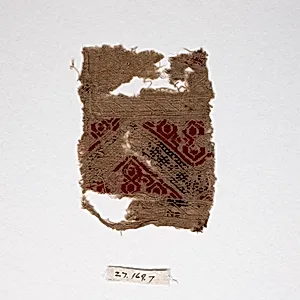
Band Fragment
Unknown Artist
12th century
Medium
Linen; embroidered in silk
Dimensions
L. 3 1/8 in. (8 cm) W. 2 7/16 in. (6.2 cm)
Classification
Textiles-Embroidered
Department
Islamic Art
Museum
Metropolitan Museum of Art, New York, NY
Credit
Rogers Fund, 1927
Accession Number
27.169.7
Rights
Public Domain
Art Historical Context
This exquisite *Band Fragment*, crafted in the 12th century, offers a glimpse into the refined world of Islamic textile artistry. Made from linen and meticulously embroidered with silk threads, this narrow strip measures just 31/8 inches long 2 7/16 inches wide. Its diminutive size hints at its original use as a decorative border—perhaps adorning garments, turbans, or household furnishings—where such embellishments signified wealth and craftsmanship. In the Islamic world of the medieval period, embroidery was a revered technique, blending practicality with opulence. Silk, a luxurious import along trade routes like the Silk Road, elevated linen's humble base into something extraordinary. Artisans employed precise stitching to create intricate patterns, often drawing from geometric and floral motifs symbolic of paradise gardens or infinite divine order. Though the artist remains unknown, this fragment exemplifies the technical mastery and cultural prestige of embroidered textiles, which were prized possessions exchanged as gifts or heirlooms. Preserved through the Rogers Fund acquisition in 1927, this piece now resides in the Metropolitan Museum of Art's Islamic Art department. For visitors, it serves as a tangible link to a vibrant era, reminding us how everyday materials could become canvases for artistic expression and spiritual devotion.