
Band Fragment
Unknown Artist
13th–14th century
Medium
Silk, metal wrapped thread; plain weave, tapestry weave
Dimensions
Textile: L. 6 3/4 in. (17.1 cm) W.13 in. (33 cm) Mount: H. 10 3/4 in. (27.3 cm) W. 17 1/2 in. (44.5 cm)
Classification
Textiles-Woven
Department
Islamic Art
Museum
Metropolitan Museum of Art, New York, NY
Credit
Gift of V. Everit Macy, 1928
Accession Number
28.217.4
Rights
Public Domain
Tags
Art Historical Context
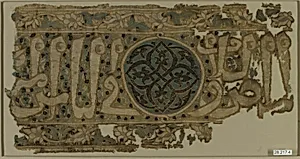
This exquisite *Band Fragment* from the13th–14th offers a glimpse into the opulent world of medieval Islamic textiles. Likely originating from the Islamic Near East or Central Asia, this narrow woven strip—measuring about 6¾ by 13 inches—was probably part of a larger garment, sash, or furnishing, adorned with intricate patterns in Arabic script. Such fragments are rare survivors, preserved thanks to the Gift of V. Everit to the Metropolitan Museum of Art in 1928, where it resides in the Department of Islamic Art. Craft from luxurious silk yarns combined with shimmering metal-wrapped threads, the piece employs a plain weave foundation for durability and a supplementary tapestry weave to create detailed motifs. Tapestry weaving, a sophisticated technique, allowed artisans to interlace colored wefts into the ground fabric, forming vivid designs without cutting threads—ideal for repeating borders like this one. The use of costly silk and metals underscores its elite status, reserved for nobility or religious contexts. In Islamic culture, textiles like this band symbolized wealth, piety, and artistry, often featuring calligraphy that evoked spiritual or poetic themes. Though incomplete, it highlights the technical mastery of anonymous weavers during a flourishing era of cross-cultural exchange along Silk Road trade routes, inviting visitors to appreciate the tactile elegance of these vanished treasures.