
Banded agate scarab
Unknown Artist
3rd century BCE
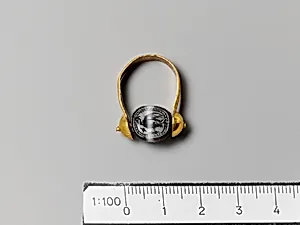
Medium
Agate, banded, gold
Dimensions
H.: 3/8 x 3/8 in. (1 x 1 cm)
Classification
Gems
Culture & Period
Etruscan · Hellenistic
Department
Greek and Roman Art
Museum
Metropolitan Museum of Art, New York, NY
Credit
Bequest of W. Gedney Beatty, 1941
Accession Number
41.160.552
Rights
Public Domain
Tags
Art Historical Context
This exquisite banded agate scarab, crafted in the 3rd century BCE during Hellenistic period, exemplifies the Etruscan mastery of miniature gem carving. Measuring just 3/8 x 3/8 inches (1 x 1 cm), this tiny jewel from the Metropolitan Museum of Art's Greek and Roman Art Department banded agate—a semi-precious stone prized for its striking natural layers—with gold accents. Donated through the bequest of W. Gedney Beatty 1941, it to the museum's renowned collection of ancient gems and seals. Scarabs like this one, though rooted in Egyptian traditions, were enthusiastically adopted by the Etruscans, an advanced Italic civilization flourishing in central Italy before Roman dominance. In the Hellenistic era, marked by cultural exchanges following Alexander the Great's conquests, Etruscans used these beetle-shaped objects as seals to authenticate documents, secure possessions, or adorn jewelry. The scarab form symbolized rebirth and protection, blending Eastern motifs with local tastes. The artist's unknown hand showcases remarkable lapidary skill: the agate's bands were likely exploited to enhance the scarab's wings and body through precise intaglio carving, creating a luminous, three-dimensional effect despite its diminutive scale. As a cultural artifact, it reveals Etruscan engagement with Mediterranean trade networks and their appreciation for portable luxury, offering visitors a window into the sophisticated daily life of antiquity.