
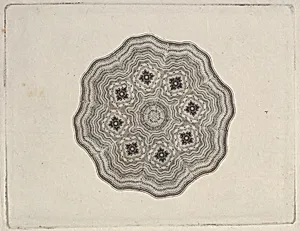
Banknote motif: rounded ornamental lathe work design with a wavy edge
Medium
Engraving on chine collé; proof
Dimensions
sheet: 2 15/16 x 2 5/16 in. (7.5 x 5.8 cm)
Classification
Prints
Department
Drawings and Prints
Museum
Metropolitan Museum of Art, New York, NY
Credit
Gift of Joseph Veach Noble, 2002
Accession Number
2002.333.35
Rights
Public Domain
Art Historical Context
This delicate engraving, created around 1824–42 by the firms A. B. & C. Durand & Company and Durand, Perkins, and Company under Cyrus Durand, showcases a rounded ornamental lathe-work design with a distinctive wavy edge. Measuring just under three inches across, it is a proof impression printed on chine collé, a technique that transfers the fine lines onto a thin sheet of Chinese paper mounted on a heavier support. Such motifs were not intended as finished artworks but as building blocks for American banknotes during a period when paper currency was proliferating and forgery posed a constant threat. Cyrus Durand’s innovative use of the geometric lathe allowed engravers to produce intricate, mathematically precise patterns that were nearly impossible to replicate by hand. These swirling, symmetrical designs served both decorative and practical purposes, forming the security backbone of early nineteenth-century currency. The small scale and proof status of this print highlight the meticulous testing process behind each element before it was incorporated into actual notes. Today, this rare surviving example offers a fascinating glimpse into the intersection of art and industry. It reminds viewers that the elaborate backgrounds on historic banknotes were the result of extraordinary craftsmanship, transforming everyday money into miniature masterpieces of precision and ingenuity.
About the Artist
A. B. & C. Durand & Company|Durand, Perkins, and Company|Cyrus Durand (American|American|American) · 1824 |1796 |1787 –1832 |1886 |1868
American, active 1824–32|American, Jefferson, New Jersey 1796–1886 Maplewood, New Jersey|American, 1787–1868