
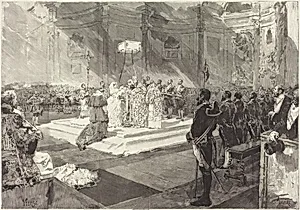
Baptême royal à la Cour d'Espagne
Medium
wood engraving
Classification
Portfolio
Department
CG-E
Museum
National Gallery of Art, Washington, D.C.
Credit
Ailsa Mellon Bruce Fund
Accession Number
2007.12.10
Rights
Public Domain
Art Historical Context
**Baptême royal à Cour d'Espagne** (Royal Baptism at the Spanish Court a wood engraving from 1882, captures a grand ceremonial moment crafted by French engraver Auguste Lepère an original design by Spanish-French illustrator Daniel Urrabieta y Vier, known simply as Daniel Vierge. intricate print, now housed in the National Gallery Art's portfolio collection (acquired through the Ailsa Mellon Fund), exemplifies the collaborative artistry of the fin-de-siècle era, where illustrators like Vierge provided dynamic sketches and master engravers like Lepère translated them into reproducible masterpieces. Wood engraving, the chosen medium, was a pinnacle of 19th-century printmaking, using end-grain wood blocks for fine, durable lines that rivaled etching. Popular in periodicals and portfolios, it democratized high art, allowing detailed depictions of historical scenes to reach wide audiences. Here, Lepère's precise technique brings to life the opulent Spanish court—likely evoking Bourbon-era splendor—with lavish attire, ornate architecture, and solemn ritual, blending Vierge's expressive style rooted in Realism and his Spanish heritage. This work reflects mid-19th-century European fascination with royal pageantry abroad, bridging French and Spanish cultural worlds amid political shifts like Spain's recent restorations. A testament to print's power, it invites visitors to ponder the pomp of monarchy through Lepère and Vierge's masterful gaze. (198 words)