
Barbe
Unknown Artist
19th century
Medium
Bobbin lace
Dimensions
L. 47 1/2 x W. 4 1/2 inches (120.7 x 11.4 cm)
Classification
Textiles-Laces
Culture
French
Department
European Sculpture and Decorative Arts
Museum
Metropolitan Museum of Art, New York, NY
Credit
Gift of Miss Augusta McKesson, 1908
Accession Number
08.116.4
Rights
Public Domain
Art Historical Context
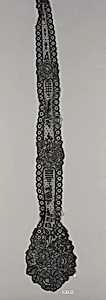
Step into the delicate world of 19th-century French lace *Barbe*, a stunning example of bobbin lace crafted by an unknown artist. Measuring an elegant 47½ by 4½ inches (120.7 x 11.4 cm), this long, narrow textile was likely designed as a wearable accessory—perhaps a lappet or falling band draped gracefully around the neck or shoulders. Housed in the Metropolitan Museum of Art's Department of European Sculpture and Decor Arts, it entered the collection as a generous gift from Miss Augusta McKesson in 1908. Bobbin lace, a meticulous handmade technique, involves intertwining threads held on small bobbins over a patterned pillow, creating intricate designs through braiding and twisting. In 19th-century France, renowned for lace-making hubs like Alençon and Valenciennes, such pieces exemplified the height of artisanal skill and patience, often requiring hundreds of hours. *Barbe* reflects this tradition, showcasing the precision and beauty of a craft that blended utility with opulence. Culturally, French bobbin laces like this one adorned the elite, symbolizing refinement and status in fashion and home décor. Though anonymous, its preservation highlights the enduring allure of textiles as fine art, inviting us to appreciate the unseen hands behind these fragile masterpieces.