
Barbe
Unknown Artist
1715–24
Medium
Needle lace
Dimensions
L. 39 x W. 5 1/2 inches (99.1 x 14.0 cm)
Classification
Textiles-Laces
Culture
French
Department
European Sculpture and Decorative Arts
Museum
Metropolitan Museum of Art, New York, NY
Credit
Gift of Thatcher M. Adams, 1914
Accession Number
14.14.1
Rights
Public Domain
Art Historical Context
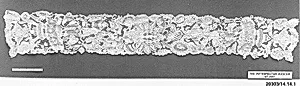
Step into the opulent world of 18th-century French fashion *Barbe*, a stunning example of needle lace crafted between 1715 and 1724. This long, narrow strip—measuring 39 by 5½ inches—was likely designed as a luxurious neck or face framing accessory, known as a "barbe," popular among the elite during the Regency period following Louis XIV's reign.orn by women of high society, it added elegance and modesty to gowns, showcasing the wearer's wealth through its delicate intricacy. Needle lace, or *point de France*, represents the pinnacle of textile artistry, where skilled artisans meticulously stitched fine linen threads into elaborate patterns using a needle alone—no bobbins required. This labor-intensive technique, centered in regions like Alençon, produced laces so fine they rivaled paintings in detail, symbolizing France's dominance in luxury crafts. *Barbe*'s creation during this era highlights the era's love for ornamental excess, bridging sculpture and decorative arts in its three-dimensional relief. Today, this anonymous masterpiece graces the Metropolitan Museum of Art's European Sculpture and Decorative Arts collection, a gift from Thatcher M. Adams in 1914. It invites us to appreciate the unseen hands behind fashion's finest details, reminding visitors of lace's role as wearable art in Versailles-era splendor.