
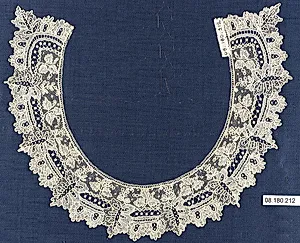
Barbe (one end)
Unknown Artist
19th century
Medium
Bobbin lace
Dimensions
L. 11 x W. 11 inches 27.9 x 27.9 cm
Classification
Textiles-Laces
Culture
Belgian, Brussels
Department
European Sculpture and Decorative Arts
Museum
Metropolitan Museum of Art, New York, NY
Credit
The Nuttall Collection, Gift of Mrs. Magdalena Nuttall, 1908
Accession Number
08.180.212
Rights
Public Domain
Art Historical Context
Behold the exquisite *Barbe (one end)*, a masterful example of 19th-centurybin lace from Brussels,—a city long celebrated as the epicenter of European lace production. Crafted by an unknown artisan, this square piece measures a precise 11 x 11 inches (27.9 x 27.9 cm) and represents one end of a *barbe*, a traditional lappet or fall often worn as part of a woman's headdress or collar in fashionable or ecclesiastical attire. Its delicate intricacy showcases the height of Brussels lace artistry, where fine linen threads were meticulously twisted and plaited to create airy patterns evoking floral motifs and geometric elegance. Bobbin lace, the medium here, involved skilled lacemakers using small bobbins to interlace hundreds of threads over a patterned pillow, a labor-intensive technique that could take weeks for a single piece. In the 19th century, Brussels lace symbolized luxury and technical virtuosity, adorning the wardrobes of European nobility and exported worldwide. This artifact, part of The Nuttall Collection gifted to the Metropolitan Museum of Art in 1908 by Mrs. Magdalena Nuttall, highlights the cultural prestige of Belgian textiles within the museum's European Sculpture and Decorative Arts department. Today, *Barbe (one end)* invites us to marvel at the anonymous hands behind such finery, preserving a slice of 19th-century craftsmanship that blended utility, beauty, and status.