
Barberini Cabinet
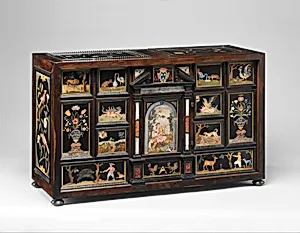
Medium
Oak and poplar veneered with various exotic hardwoods, with ebony moldings and plaques of marble, slate (paragon); pietre dure work consisting of colored marbles, rock crystal, and various hardstones
Dimensions
23 1/4 x 38 1/8 x 14 1/8 in. (59.1 x 96.8 x 35.9 cm)
Classification
Woodwork-Furniture
Culture
Italian, Florence
Department
European Sculpture and Decorative Arts
Museum
Metropolitan Museum of Art, New York, NY
Credit
Wrightsman Fund, 1988
Accession Number
1988.19
Rights
Public Domain
Tags
Art Historical Context
Step into the opulent world of early 17th-century Florence with the Barberini Cabinet, a masterpiece of luxury furniture crafted around 1606–23 by the Galleria dei Li workshop and designer Francesco Del Tuppo. in the Medici court's renowned stoneworking atelier—the precursor to the Opificio delle Piet Dure—this compact cabinet (just over 38 inches wide) exemplifies Renaissance Italy's shift toward Baroque grandeur. Likely created for elite patrons, its name evokes the powerful Barberini family of Rome, hinting at diplomatic gifts or princely collections that bridged Florence and papal circles. The cabinet's allure lies in its virtuoso techniques: oak and poplar veneered with exotic hardwoods, framed by ebony moldings, and adorned with intricate *pietre dure*—inlays of colorful marbles, rock crystal, slate, and hardstones. This labor-intensive method, a Florentine specialty, creates vivid, jewel-like scenes of hunting motifs: boars chased by dogs and hunters, sly foxes, majestic lions and deer, playful roosters and birds, plus symbolic salamanders (echoing Medici heraldry) amid blooming flowers. Such naturalistic vignettes celebrated the thrill of the chase, a noble pastime symbolizing power and harmony with nature. Housed in The Metropolitan Museum of Art's European Sculpture and Decorative Arts collection (acquired via the Wrightsman Fund in 1988), this cabinet transports visitors to an era when furniture was both functional art and status symbol, blending technical precision with storytelling flair.
About the Artist
Galleria dei Lavori, Florence|Francesco Del Tuppo ( |Italian) · |1443 – |1501
|Italian, 1443/44–1501