
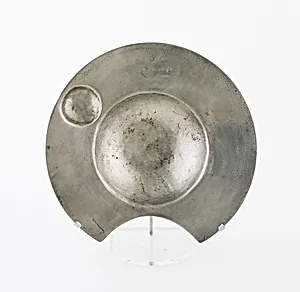
Barber's Bowl
c. 1680
Medium
Pewter
Dimensions
4.5 × 24.1 cm (1 3/4 × 9 1/2 in.)
Classification
personal grooming / hygiene / cosmetic container
Department
Applied Arts of Europe
Museum
Art Institute of Chicago
Accession Number
89306
Rights
Public Domain
Art Historical Context
Created around 1680 by English pewterer William Allen, this Barber’s Bowl exemplifies the refined functional objects that populated European households during the late seventeenth century. Pewter, an alloy prized for its smooth finish and durability, was the material of choice for items that combined everyday utility with modest elegance. At just under ten inches across, the bowl’s modest scale suited the intimate rituals of shaving and washing, reflecting a period when personal grooming was both a practical necessity and a mark of social refinement. As a work in the Applied Arts of Europe collection, the piece highlights how skilled artisans like Allen elevated ordinary hygiene tools into objects of quiet beauty. Pewter’s soft luster and ability to hold crisp forms made it ideal for such vessels, which were common in barbers’ shops private homes alike. Today, the bowl offers visitors a tangible connection to daily life in Restoration-era Europe, where craftsmanship transformed even the simplest acts of care into moments of understated grace.