
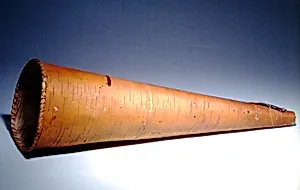
Bark Trumpet / Moose Call
Unknown Artist
19th century
Medium
birch bark, cord
Dimensions
Greatest Diam. 15.8 x L. 52cm (6 1/4 x 20 1/2in.)
Classification
Aerophone-Lip Vibrated-trumpet / trombone
Culture
Native American (Mic Mac)
Department
Musical Instruments
Museum
Metropolitan Museum of Art, New York, NY
Credit
The Crosby Brown Collection of Musical Instruments, 1889
Accession Number
89.4.696
Rights
Public Domain
Art Historical Context
This striking 19th-century instrument, created by a Mi’kmaq artist, exemplifies the resourceful ingenuity of Native American craftsmanship. Made from rolled birch bark secured with cord, the trumpet measures just over twenty inches long and was designed to produce resonant tones through lip vibration. Its dual identity as both a musical aerophone and a moose call highlights how Indigenous communities seamlessly blended practical hunting needs with expressive sound-making traditions. Birch bark, a material long valued by the Mi’kmaq for its flexibility, durability, and natural acoustic properties, was carefully shaped to amplify sound across forested landscapes. Such calls allowed hunters to mimic animal vocalizations, demonstrating deep ecological knowledge passed through generations. The object’s presence in the Metropolitan Museum’s Crosby Brown Collection since 1889 underscores its significance as both a functional tool and a cultural artifact that bridges daily life and artistic expression. Today, this modest yet powerful instrument invites visitors to consider the rich sonic heritage of Indigenous peoples and the ways natural materials can become voices of tradition and survival.