
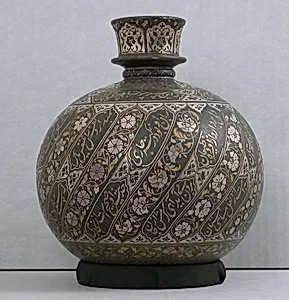
Base for a Water Pipe (Huqqa) with Poetry and Flowers
Unknown Artist
early 18th century
Medium
Zinc alloy; cast, engraved, inlaid with silver and brass (bidri ware)
Dimensions
H. 8 5/8 in. (21.9 cm) Diam. 7 1/4 in. (18.4 cm)
Classification
Metal
Department
Islamic Art
Museum
Metropolitan Museum of Art, New York, NY
Credit
Purchase, Friends of Islamic Art Gifts, 2003
Accession Number
2003.271
Rights
Public Domain
Tags
Art Historical Context
This exquisite base for a huqqa, or water pipe, hails from the early 18th and exemplifies the masterful bidri ware tradition of the Deccan region in India. Crafted a zinc alloy, the piece was cast, meticulously engraved, and in with silver and brass, a striking contrast against its surface. Measuring just 8 5/8 high and 7 1/4 inches in diameter, its compact form belies its intricate beauty, adorned with delicate floral motifs and poetic inscriptions—hallmarks of Islamic decorative arts that blend utility with elegance. Bidri ware, named after the town of Bidar, represents a pinnacle of metalworking skill in Mughal-era India. Artisans first cast the zinc-based alloy, then engraved fine patterns before hammering in silver and brass wires for in. A chemical treatment, often using soil from the region, produced the signature black patina, making the shimmering inlays pop like jewels. The poetry and flowers evoke the refined aesthetic of Persianate culture, where such verses often celebrated love, nature, or mysticism. In Islamic societies, huqqas were more than smoking devices for tobacco—introduced via Portuguese trade—they were social centerpieces fostering conversation in courts and homes. This rare survivor, acquired by the Metropolitan Museum of Art in 2003, offers a window into the opulent craftsmanship of early modern South Asia, where everyday objects became canvases for poetic artistry.