
Base for an oil lamp
ca. 1530 - ca. 1539
Medium
bronze (metal)
Dimensions
18.8; 21.5; 11; 18.5
Rights
Public Domain
About this artwork
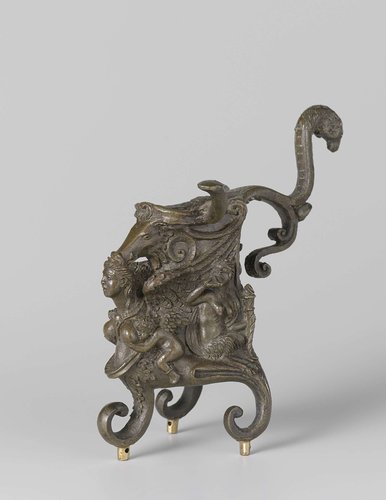
Op de hoek aan de voorzijde van de driezijdige voet, die rust op drie naar voren krullende poten, bevindt zich een sirene, wier uitgespreide vleugels tegen de zijwanden van de voet liggen. Bovenaan ontspringt de kop van een everzwijn, die zijn snuit tegen het naar voren gestrekte hoofd van de sirene houdt. De laatste draagt om de hals een brede band met als sieraad een runderschedel en om haar middel een sleufband, waaronder afhangende acanthusbladeren. Deze bedekken deels de zich daaronder bevi...
Art Historical Context
This exquisite bronze base for an oil lamp, created by the Paduan sculptor Andrea Briosco (known as Riccio) around 1530–1539, exemplifies the refined artistry of the Italian Renaissance. Standing just 21.5 cm tall, the three-sided form rests on curling feet and teems with mythological imagery that reflects the period’s deep fascination with classical antiquity. Briosco, celebrated for his small-scale bronzes, masterfully combined intricate reliefs and symbolic motifs to transform a functional object into a miniature work of art. At its center stands a siren whose wings spread across the sides, embraced by a boar’s head above and flanked by drinking putti, satyrs playing panpipes, and a female satyr with a torch. An oval plaque on the reverse depicts Jupiter on an eagle confronting a nude woman beside Cupid, inscribed “Cupidus,” evoking ancient Roman gems. Delicate acanthus leaves, shells, and a ram’s-head handle complete the design, showcasing the lost-wax casting technique that allowed such precise, lively details. Riccio’s work captures the Renaissance revival of pagan themes and humanist learning, where everyday luxury items like lamp bases became vehicles for storytelling and classical knowledge. Its compact scale and rich symbolism made it ideal for a scholar’s study or collector’s cabinet, blending utility with intellectual delight.