
Basin
1685–1700
Classification
ceramics
Department
Smithsonian Collection
Museum
Smithsonian American Art Museum
Credit
Museum purchase from Charles E. Sampson Memorial Fund
Accession Number
2020-4-1
Rights
Public Domain
About this artwork
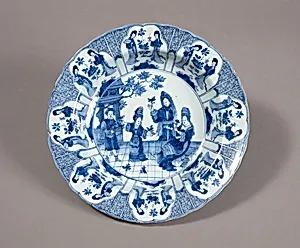
Chinese export blue and white deep bowl, or basin. The central scene of the interior is painted in deep underglaze blue with European court ladies standing on a terrace strewn with flowers, each holding a floral sprig to smell while a servant to one side bears a basket of more flowers. The exterior is decorated with freely painted with floral sprigs.
Art Historical Context
This exquisite blue-and-white porcelain basin, crafted in China around 1685–1700, exemplifies the artistry of the Kangxi period (1661–1722) in the Qing dynasty. As a deep bowl designed for export to Europe, its interior features a lively underglaze blue scene of elegant European court ladies on a flower-strewn terrace. Each delicately sniffs a floral sprig, attended by a servant carrying a basket of blooms, while the exterior blooms with freely painted floral motifs. Likely produced in Jingdezhen, the porcelain capital, this piece highlights cobalt-blue pigmentation fired at high temperatures for a vibrant, durable finish. Historically, such export wares fueled a craze for chinoiserie in Europe, blending Chinese technical mastery with Western imagery interpreted through Eastern eyes. Chinese potters, adapting to foreign markets, depicted imagined European nobility, fostering cultural exchange amid booming trade via the Dutch East India Company. This basin, now in the Smithsonian American Art Museum (purchased via the Charles E. Sampson Memorial Fund), served practical uses like washing while doubling as a status symbol. Its artistic significance lies in the harmonious fusion of meticulous underglaze painting—resistant to wear—and whimsical motifs, bridging continents and eras for today's visitors.