
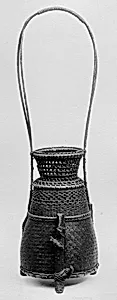
Basket
Unknown Artist
19th century
Medium
Bamboo
Dimensions
H. (with handle) 26 in. (66 cm); W. 8 3/4 in. (22.2 cm)
Classification
Basketry
Culture & Period
Japan · Edo (1615–1868) or Meiji period (1868–1912)
Department
Asian Art
Museum
Metropolitan Museum of Art, New York, NY
Credit
Edward C. Moore Collection, Bequest of Edward C. Moore, 1891
Accession Number
91.1.2077
Rights
Public Domain
Art Historical Context
This elegant bamboo basket, crafted by an unknown Japanese artisan in the 19th century exemplifies the refined artistry of Edo (1615–1868) or early Meiji (1868–1912) period basketry. Standing tall at 26 inches high with its handle and 8¾ inches wide, it reflects the practical yet aesthetically pleasing utilitarian objects common in Japanese daily life and tea ceremonies. During the Edo era, Japan’s isolation fostered mastery in folk crafts, while the Meiji period introduced subtle Western influences amid rapid modernization. Bamboo, a versatile and abundant material, was woven using intricate plaiting techniques that highlight the basketmaker’s skill in creating lightweight, durable forms with natural flexibility and strength. These baskets often served functional roles—storing tea, flowers, or rice—while embodying wabi-sabi principles of humble beauty and imperfection. Now part of the Metropolitan Museum of Art’s Asian Art collection, this piece entered through the 1891 bequest of Edward C. Moore, a pioneering collector of Japanese works. It invites visitors to appreciate the anonymous genius of Japanese craftsmanship, bridging utility and art across centuries.