
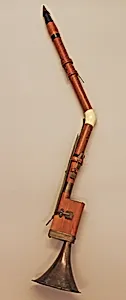
Basset Horn in F
ca. 1800
Medium
Boxwood, brass, horn
Dimensions
L.: 95 cm (37-1/2); Diam. of bell (ovoid): 15 cm (6 in.); Mouthpiece: 8.3 cm (3-1/4 in.); Barrel: 7.2 cm (2-7/8 in.); Upper body section: 30.5 cm (12 in.); Replacement for elbow (actually a barrel): 6.7 cm (2-5/8 in.); Mid-body section: 13.8 cm (5-1/2 in.); 11.6 cm (4-7/8 in.); 15.1 cm (6 in.); 14.9 cm (5-7/8 in.)
Classification
Aerophone-Reed Vibrated-single reed cylindrical
Culture
Slovenian
Department
Musical Instruments
Museum
Metropolitan Museum of Art, New York, NY
Credit
The Crosby Brown Collection of Musical Instruments, 1889
Accession Number
89.4.2143
Rights
Public Domain
Art Historical Context
This basset horn in F, crafted around 1800 by Slovenian maker Simon Unglerth, represents a refined example of early nineteenth-century woodwind instrument design. Classified as a single-reed aerophone with a cylindrical bore, it was constructed primarily from boxwood, accented with brass fittings and a horn bell. The instrument’s elongated form—nearly a meter in length—allowed for a rich, mellow tone suited to chamber and orchestral settings of the period. Unglerth’s work highlights the skilled craftsmanship of Slovenian artisans, who contributed to the evolution of reed instruments during a time when composers were exploring new tonal colors. The use of natural materials like boxwood provided both acoustic resonance and durability, while the brass and horn elements added structural strength and visual elegance. Such instruments were prized for their expressive range and became important voices in classical ensembles. Acquired in 1889 as part of the Crosby Brown Collection, this basset horn now resides in the Metropolitan Museum of Art’s Department of Musical Instruments. Its detailed construction, including multiple jointed sections and a distinctive ovoid bell, offers visitors a tangible connection to the musical innovations of its era.