
Bassorilievo dell'arco di Tito
1848–52
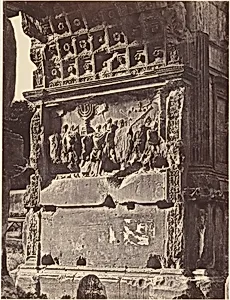
Medium
Albumen print from glass negative
Dimensions
Image: 11 5/16 × 8 5/8 in. (28.8 × 21.9 cm) Sheet: 18 1/2 × 12 1/8 in. (47 × 30.8 cm)
Classification
Photographs
Department
Photographs
Museum
Metropolitan Museum of Art, New York, NY
Credit
Gilman Collection, Museum Purchase, 2005
Accession Number
2005.100.799 (27)
Rights
Public Domain
Tags
Art Historical Context
In the mid-19th century, photographer Eugène Constant captured intricate details of ancient Roman artistry with *Bassorilievo dellco di Tito* (Bas-Relief of the Arch of), an albumen print a glass negative made between 1848 and 1852. This photograph documents a famous triumphal arch in Rome's Forum Romanum, built around 81 CE by Emperor Domitian commemorate his brother Titus's victory over in 70 CE. The bas-relief depicts Roman soldiers carrying spoils from the Second Temple, including the golden menorah—a poignant symbol of historical conquest that resonates in Jewish and Roman narratives. Constant's image exemplifies early photography's power as a documentary tool, preserving architectural sculpture with remarkable clarity. Albumen prints, coated with egg whites for a glossy surface and rich tonality, were revolutionary for rendering fine textures like the flowing drapery and dynamic figures on the arch. At 11 5/16 × 8 5/8 inches, this intimate yet precise view brought classical antiquity to global audiences, bridging 19th-century innovation with imperial Rome's grandeur. Part of the Metropolitan Museum of Art's Gilman Collection, this work highlights photography's role in art history, transforming static ruins into vivid, accessible records for scholars and enthusiasts alike.
About the Artist
Eugène Constant · 1848–1855
Eugène Constant (before 1820 – after 1860) was a French painter who became one of the pioneering photographers of the 19th century, capturing the grandeur of Italy's ancient monuments with unprecedented clarity.) Trained as a painter in Paris during the early 1840s, where he maintained a studio at 31 rue du Marché-Saint-Honoré, Constant exhibited interior views of Venice's Basilica of San Marco an...