
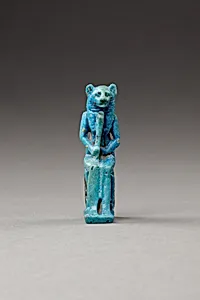
Bastet amulet
Unknown Artist
664–30 B.C.
Medium
Faience
Dimensions
h. 5.8 cm (2 5/16 in.)
Classification
Amulet, Bastet seated, openwork base
Period
Late Period–Ptolemaic Period
Department
Egyptian Art
Museum
Metropolitan Museum of Art, New York, NY
Credit
Rogers Fund, 1944
Accession Number
44.4.37
Rights
Public Domain
Art Historical Context
This charming faience amulet depicts Bastet, the ancient Egyptian goddess of protection, fertility, and domestic joy, often portrayed as a cat-headed woman. Crafted during Egypt's Late Period to Ptolemaic era (664–30 B.C.), when foreign influences blended with enduring pharaonic traditions, such small talismans were everyday guardians. At just 5.8 cm tall, it was likely worn as jewelry or carried for personal safeguarding against evil spirits or misfortune—a testament to the Egyptians' deep belief in divine intercession in daily life. Faience, a glazed composite of quartz, lime, and clay fired to a brilliant turquoise or blue, was prized for its vibrant, gem-like sheen symbolizing eternity and the Nile's life-giving waters. This technique, perfected over millennia, made affordable amulets accessible beyond elites, democratizing spirituality. The Met's example, acquired via the Rogers Fund in 1944, exemplifies the period's refined miniaturism, where intricate details like Bastet's poised stance and protective posture conveyed power in pocket-sized form. Visitors to the Egyptian Art galleries will appreciate how this unassuming artifact bridges the mystical and mundane, revealing a culture where gods walked among people.