
Bastiano
Medium
engraving on laid paper
Dimensions
sheet (trimmed to plate mark): 13 × 8.5 cm (5 1/8 × 3 3/8 in.)
Classification
Department
CG-E
Museum
National Gallery of Art, Washington, D.C.
Credit
R.L. Baumfeld Collection
Accession Number
1969.15.334
Rights
Public Domain
Art Historical Context
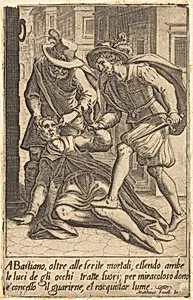
This small engraving titled *Bastiano*, created in 1619 by Jacques Callot after a design by the Florentine painter Matteo Rosselli, captures the refined printmaking traditions of the early Baroque period. Measuring just 13 by 8.5 centimeters, the work exemplifies Callot’s masterful command of line and detail on laid paper. As a reproductive print, it translates Rosselli’s original composition into an accessible format, allowing viewers far beyond Florence to encounter the figure of Bastiano—likely a character or portrait subject popular in early seventeenth-century Italy. Jacques Callot, a French artist who spent formative years working in Italy, was celebrated for elevating engraving into an art form capable of remarkable precision and narrative richness. His technique here demonstrates the period’s growing interest in portable, affordable images that bridged painting and print culture. Produced during Callot’s Italian sojourn, the engraving reflects the lively exchange of artistic ideas between Florence and northern Europe. Housed in the National Gallery of Art as part of the R.L. Baumfeld Collection, this intimate print highlights how engravings served both as artistic records and vehicles for cultural exchange in the seventeenth century. Its modest scale invites close looking, revealing the subtle textures and expressive qualities that made Callot’s work so influential among later generations of printmakers.