
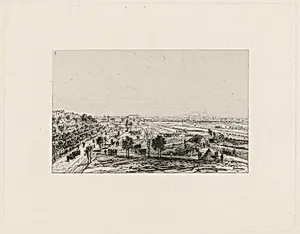
Bastion 49
1871
Medium
etching on wove paper
Dimensions
image: 8.8 × 14.1 cm (3 7/16 × 5 9/16 in.) plate: 16.2 × 20.9 cm (6 3/8 × 8 1/4 in.) sheet: 25.4 × 30 cm (10 × 11 13/16 in.)
Classification
Department
CG-E
Museum
National Gallery of Art, Washington, D.C.
Credit
Gift of Carol and James Goodfriend
Accession Number
2021.113.27
Rights
Public Domain
Art Historical Context
**Bastion 49** *Maxime Lalanne, 1871* Etching on wove paper Created in 1871, *Bastion 49* is a delicate etching by French artist Maxime Lalanne, capturing a moment amid the turmoil of the Franco-Prussian War and the Paris Commune. Lalanne, a master etcher renowned for his precise depictions of Parisian architecture and urban life, turned his gaze to the city's defenses during the Siege of Paris (1870–71). The title refers to one of the numbered bastions along Paris's Thiers Wall, fortified ramparts that symbolized the city's desperate resistance against Prussian forces. This small-scale print (image: 8.8 × 14.1 cm) evokes the gritty reality of wartime Paris, where civilians endured bombardment and shortages. Lalanne's etching technique shines here: using acid to bite intricate lines into a metal plate, he achieved remarkable detail and texture on smooth wove paper, ideal for reproducing fine architectural elements like stonework and shadows. Part of the 19th-century etching revival, his work bridged Realism and emerging Impressionist interests in light and atmosphere. Housed in the National Gallery of Art's Prints department (gift of Carol and James Goodfriend), this piece offers visitors a poignant window into a pivotal chapter of French history, blending technical virtuosity with human resilience.
About the Artist
Maxime Lalanne · 1827–1886
François Antoine Maxime Lalanne (1827–1886) was born in Bordeaux into a family of civil servants, initially pursuing classical studies and a law career. At the Institution Oré, he learned drawing from instructor Saulnier and showed early promise, exhibiting pencil and pastel works at Bordeaux's Philomathique Society in 1850, where he earned a bronze medal. Encouraged by architect Léo Drouyn, Lalan...