
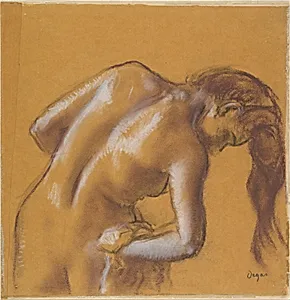
Bather Drying Herself
ca. 1892
Medium
Charcoal and pastel, heightened with white chalk, on tracing paper (mounted on cardboard)
Dimensions
Sheet: 10 3/8 x 10 3/8 in. (26.4 x 26.4cm)
Classification
Drawings
Department
Drawings and Prints
Museum
Metropolitan Museum of Art, New York, NY
Credit
Bequest of Stephen C. Clark, 1960
Accession Number
61.101.18
Rights
Public Domain
Tags
Art Historical Context
In the late 19th century, Edgar D captured the quiet, private moments of everyday life with unparalleled intimacy, and *Bather Drying Herself (ca. 1892) exemplifies this fascination. This square-format drawing depicts a woman in a candid bathing pose, part of Degas' extensive series exploring female nudes absorbed in rituals. As a leading figure in Impressionism—though he rejected the label—Degas blended realist precision with innovative compositions, often viewing his subjects from unconventional angles to evoke a sense of voyeuristic immediacy. Crafted in charcoal and pastel heightened with white chalk on tracing paper (mounted on cardboard), the work showcases Degas' mastery of mixed media during his later years, when declining eyesight drew him to the vibrant, tactile qualities of pastel. The translucent tracing paper enhances luminosity, allowing layered colors to glow softly, while bold chalk highlights accentuate the bather's form and movement. At just 10 3/8 x 10 3/8 inches, its intimate scale invites viewers into a fleeting, unguarded instant. Housed in the Metropolitan Museum of Art's Drawings and Prints department (Bequest of Stephen C. Clark, 1960), this piece highlights Degas' enduring influence on modern depictions of the female body, celebrating vulnerability and grace amid the era's shifting views on privacy and femininity.
About the Artist
Edgar Degas · 1834–1917
Edgar Degas (1834-1917) stands as one of the most innovative artists of the nineteenth century, whose distinctive vision transformed how modern life could be depicted on canvas. Born Hilaire-Germain-Edgar De Gas in Paris to a wealthy banking family—his father French, his mother a Louisiana Creole from New Orleans—Degas received a classical education before abandoning law studies in 1855 to pursue ...