
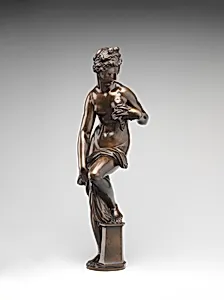
Bathing Venus
early 17th century
Medium
Bronze
Dimensions
Height: 13 1/4 in. (33.7 cm)
Classification
Sculpture-Bronze
Culture
Italian, Florence
Department
European Sculpture and Decorative Arts
Museum
Metropolitan Museum of Art, New York, NY
Credit
Gift of Ogden Mills, 1924
Accession Number
24.212.16
Rights
Public Domain
Tags
Art Historical Context
Nestled in the Metropolitan Museum of Art's European Sculpture and Decorative collection, *Bathing Venus* is exquisite bronze sculpture by the renowned Florentine artist Giambologna (Giovanni da), dating to the early 17 century. Standing at ¼ inches (33.7 cm) tall, this intimate work captures the goddess Venus in a moment of graceful bathing, her nude form twisting elegantly as water cascades from a shell or cloth. Gifted to the Met by Ogden Mills in 192, it exemplifies the refined artistry of Italian Renaissance workshops. Giambologna, a master of Mannerism, revolutionized sculpture with his dynamic poses and elongated proportions, blending classical mythology with innovative techniques like lost-wax casting. This allowed for the bronze's smooth, lustrous patina and intricate details, from the subtle play of muscles to the flowing drapery. Venus as bather evokes ancient Roman ideals of beauty and fertility, a popular motif among Renaissance collectors for private gardens or studioli. As a small-scale bronze, *Bathing Venus* highlights the era's fascination with portable luxury art, bridging sculpture and decorative objects. Its poised sensuality invites viewers to appreciate the harmonious fusion of anatomy, movement, and myth in Florence's golden age of bronzework.
About the Artist
Giambologna · 1529–1608
Born and trained in Flanders (Douai, his birthplace, is now in France but was once in Flanders), Giambologna traveled to Italy in 1550 to study Classical and Renaissance sculpture. There, he became court sculptor of the Medici Dukes. He was famed for compositional sophistication, sensuous, tactile treatment of human body, and sheer technical virtuosity. He was extremely influential because the Med...