
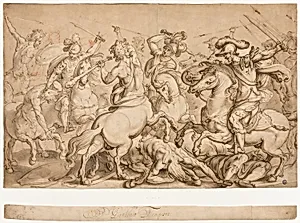
Battle of the Lapiths and Centaurs
c. 1600
Medium
Pen and ink, and brush and brown and gray wash, red chalk, and white gouache, over traces of black chalk, on ivory laid paper; incised
Dimensions
40.9 × 65.1 cm (16 1/8 × 25 11/16 in.)
Classification
pen and ink drawings
Department
Prints and Drawings
Museum
Art Institute of Chicago
Accession Number
84513
Rights
Public Domain
Art Historical Context
This dynamic drawing by Antonio Tempesta captures the fierce mythological clash between the Lapiths, a civilized Greek tribe, and the unruly centaurs during their wedding feast brawl. Created around 1600, scene embodies themes of order versus chaos that resonated strongly in Renaissance and early Baroque art. Tempesta, an Italian artist celebrated for his energetic battle compositions, brings the ancient story to life through a whirlwind of figures locked in combat. The work showcases Tempesta’s masterful command of mixed media—pen and ink, brown and gray washes, red chalk, and white gouache—applied over traces of black chalk on ivory laid paper. These layered techniques create dramatic contrasts of light and shadow, heightening the sense of movement and tension across the wide composition. The incised lines further suggest the drawing may have served as a preparatory study for an engraving, reflecting the artist’s frequent practice of translating drawings into widely circulated prints. Measuring just over 16 by 25 inches, this sheet from the Art Institute of Chicago’s Prints and Drawings collection offers viewers an intimate glimpse into Tempesta’s creative process. Its rich surface and vigorous draftsmanship invite close looking, revealing the artist’s skill at conveying both the brutality and theatricality of this timeless story.
About the Artist
Antonio Tempesta · 1555–1630
Antonio Tempesta (1555–1630), known as 'Il Tempestino,' was a Florentine painter and printmaker whose extraordinary output of approximately 1,700 etchings made him one of the most influential printmakers of the early Baroque period. Born in Florence and trained under Santi di Tito and the Flemish master Joannes Stradanus, he enrolled in the Accademia del Disegno in 1576 before relocating to Rome i...