
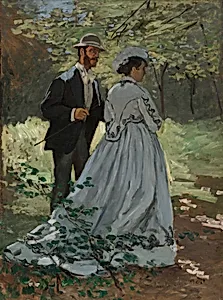
Bazille and Camille (Study for "Déjeuner sur l'Herbe")
1865
Medium
oil on canvas
Dimensions
overall: 93 x 68.9 cm (36 5/8 x 27 1/8 in.) framed: 121.9 x 98.4 x 10.7 cm (48 x 38 3/4 x 4 3/16 in.)
Classification
Painting
Department
CF
Museum
National Gallery of Art, Washington, D.C.
Credit
Ailsa Mellon Bruce Collection
Accession Number
1970.17.41
Rights
Public Domain
Art Historical Context
In 1865, Claude Monet created *Bazille and CamilleStudy for "Déjeuner l'Herbe")*, an oil on canvas painting measuring 93 x 68.9 cm, now housed in the National Gallery of as part of the Ailsa Bruce Collection. This intimate study captures two figures—Frédéric Bazille, a fellow aspiring artist and close friend who tragically died young in the Franco-Prussian War, and Doncieux, Monet's future wife and frequent muse—posed in a sun-dappled outdoor setting. It served as a preparatory work for Monet's ambitious large-scale painting *Déjeuner sur l'Herbe*, directly inspired by Édouard Manet's scandalous 1863 masterpiece of the same name. As an early work by Monet, then in his mid-20s, this piece bridges academic traditions with the innovative loose brushwork and vibrant color that would define Impressionism. Painted en plein air, it showcases Monet's growing fascination with natural light and everyday subjects, departing from the polished finishes of Salon-approved art. The oil medium allowed for fluid layering, evident in the textured foliage and luminous skin tones, foreshadowing his revolutionary outdoor studies. This study not only reveals the camaraderie among Paris's avant-garde artists but also highlights Monet's bold engagement with contemporary controversy, making it a charming window into the birth of modern painting.
About the Artist
Claude Monet · 1840–1926
Claude Monet, born Oscar-Claude Monet on November 14, 1840, in Paris and raised in Le Havre, Normandy, began his artistic journey as a successful teenage caricaturist. His formal training started at the Le Havre secondary school of the arts in 1851, where he received his first drawing lessons from Jacques-François Ochard. Around 1858, he met Eugène Boudin, who became his pivotal mentor, introducin...