
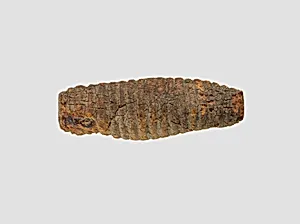
Bead
Unknown Artist
ca. 9th century BCE
Medium
Amber
Dimensions
0.55 x 1.85 in. (1.4 x 4.7 cm)
Classification
Stone-Ornaments
Culture & Period
Iran · Iron Age II, Hasanlu Period IV
Department
Ancient Near Eastern Art
Museum
Metropolitan Museum of Art, New York, NY
Credit
Rogers Fund, 1965
Accession Number
65.163.79
Rights
Public Domain
Art Historical Context
This delicate amber bead, dating to around the 9th century, hails from Iron Age II Iran during the Hasanlu Period. Measuring just 0.55 x 1.85 inches, it exemplifies the exquisite craftsmanship of ancient personal ornaments from the Ancient Near East. Crafted from amber—a fossilized tree resin prized for its warm, golden translucence—this tiny gem was likely worn as jewelry or used in rituals, reflecting everyday luxury in a bustling ancient society. Excavated from the Hasanlu site in northwestern Iran, a key urban center violently destroyed around this time, the bead offers a glimpse into vibrant trade networks. Amber, not native to the region, was probably imported from distant Baltic sources, underscoring the era's far-reaching commerce and cultural exchanges across Eurasia. Such ornaments highlight the technical skill of ancient artisans, who polished and shaped the soft resin without modern tools, preserving its natural luster for millennia. Today, housed in the Metropolitan Museum of Art's Ancient Near Eastern Art department (acquired via the Rogers Fund in 1965), this unassuming bead connects us to the lives of Iron Age people—reminding visitors that beauty often lay in the smallest treasures of antiquity.