
Bead
Unknown Artist
probably 8th–12th century
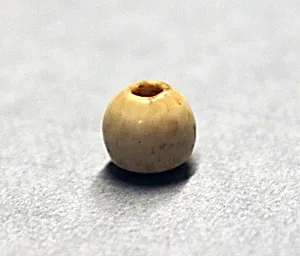
Medium
Ivory (?)
Dimensions
Ht. 1/4 in. (0.7 cm) W. 1/4 in. (0.7 cm) D.1/4 in. (0.7 cm)
Classification
Ivories and Bone
Department
Islamic Art
Museum
Metropolitan Museum of Art, New York, NY
Credit
Rogers Fund, 1948
Accession Number
48.101.74
Rights
Public Domain
Art Historical Context
Nestled in the Metropolitan Museum of Art's Islamic collection, this diminutive bead—measuring just a quarter-inch (0.7 cm) in every dimension—offers a glimpse into the refined craftsmanship of the medieval Islamic world. Dated probably to the 8th–12th centuries, it hails from a period of vibrant cultural exchange across the Abbasid and early Seljuk realms, where artisans transformed materials like ivory (or possibly bone) into everyday treasures. Acquired through the Rogers Fund in 8 and classified among Ivories and Bone, its compact, cube-like form speaks to the precision required for such small-scale work. Though its unknown creator remains anonymous, the bead exemplifies the technical mastery of Islamic ivories, often carved with subtle facets or perforations for stringing into jewelry, rosaries, or amulets. Ivory, prized for its smooth texture and workability, was a favored medium in regions from Egypt to Persia, symbolizing both luxury and portability in trade routes like the Silk Road. Its survival underscores the durability of these materials amid centuries of use. This unassuming artifact invites us to marvel at the unsung artistry of daily life: a single bead that once adorned a necklace or prayer strand, bridging personal devotion and aesthetic beauty in a golden age of Islamic innovation.