
Bead
Unknown Artist
8th–13th century
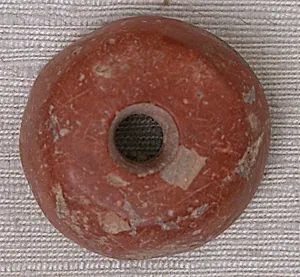
Medium
Stone; cut and drilled
Dimensions
48.101.184a: Ht. 1/2 in. (1.2 cm) Diam. 1 in. (2.5 cm) 48.101.184b: Ht. 1/4 in. (0.7 cm) W. 1 1/8 in. (2.8 cm) 48.101.184c: Ht. 1/8 in. (0.3 cm) W. 1 1/4 in. (3.1 cm)
Classification
Stone
Department
Islamic Art
Museum
Metropolitan Museum of Art, New York, NY
Credit
Rogers Fund, 1948
Accession Number
48.101.184a–c
Rights
Public Domain
Art Historical Context
Nestled in the Metropolitan Museum of Art's Islamic collection, these three stone beads (accession numbers 48.101.184a–c), dating from the 8th to 13th century, offer a glimpse into the everyday artistry of the Islamic world. Crafted from stone and meticulously cut and, they vary in size—from the largest at 1 inch in diameter to the smallest just 1/8 inch high—revealing the of ancient lapidary techniques. through the Rogers Fund in 8, these unassuming objects highlight the Met's commitment to preserving subtle treasures of Islamic material culture. During this expansive period, spanning the Abbasid Caliphate and beyond, stone beads like these were integral to jewelry, prayer strings, and trade goods across the vast Islamic networks from the Middle East to North Africa and Central Asia. The act of cutting and drilling hard stone demanded skilled craftsmanship, often using rudimentary tools like bow drills and abrasives, underscoring the technical prowess of artisans who transformed raw materials into functional beauty. While their exact origin remains unknown, such beads symbolized wealth, spirituality, and connectivity in a thriving cosmopolitan era. Pause to admire their smooth perforations—perfect for stringing into necklaces or rosaries. These modest artifacts remind us that Islamic art's brilliance often lay in its utilitarian elegance, bridging personal adornment with profound cultural traditions.