
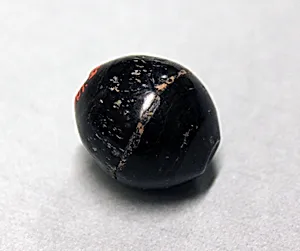
Bead
Unknown Artist
8th–13th century
Medium
Stone, probably jet; cut and drilled
Dimensions
Ht. 11/16 in. (1.7 cm) W. 11/16 in. (1.7 cm) D. 9/16 in. (1.5 cm)
Classification
Stone
Department
Islamic Art
Museum
Metropolitan Museum of Art, New York, NY
Credit
Rogers Fund, 1948
Accession Number
48.101.219
Rights
Public Domain
Art Historical Context
Nestled in the Metropolitan Museum of Art's Islamic collection, this unassuming yet exquisite bead hails from the vibrant Islamic world of the 8th to 13th centuries. Crafted from stone—likely jet, a black lignite prized for its smooth polish and luster—the bead measures just 11/16 inches high and wide, with a depth of 9/16 inches. Its cut and drilled form reveals masterful craftsmanship, allowing it to be strung intolaces, bracelets, or prayer beads, everyday items that carried deep personal and cultural weight. During this expansive era, spanning the Abbasid Caliphate's golden age through turbulent times of regional dynasties, such beads were ubiquitous in trade networks from the Mediterranean to Central Asia. Jet, with its deep sheen resembling onyx, symbolized elegance and protection in jewelry and amulets. The drilling technique, requiring steady hands and fine tools, underscores the technical sophistication of Islamic artisans, who elevated utilitarian objects into art through meticulous detail. Acquired through the Rogers Fund in 1948, this bead invites us to ponder the lives of its anonymous wearers—merchants, scholars, or nomads—whose adornments bridged cultures and centuries. A tiny portal to medieval Islamic ingenuity!