
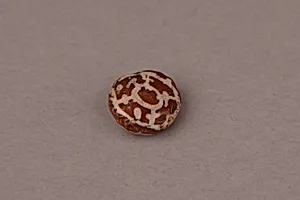
Bead
Unknown Artist
9th–19th century
Medium
Carnelian
Dimensions
H. 7/16 in. (1.1 cm) W. 7/16 in. (1.1 cm) D. 3/16 in. (0.5 cm)
Classification
Glass
Department
Islamic Art
Museum
Metropolitan Museum of Art, New York, NY
Credit
Bequest of Mary Anna Palmer Draper, 1915
Accession Number
15.43.338
Rights
Public Domain
Art Historical Context
This petite carnelian bead, dating from the 9th to 19th century exemplifies the enduring craftsmanship of Islamic art. Crafted from carnelian—a vibrant red semi-precious stone prized for its warm translucency and durability—the bead measures just 7/16 inch (1.1 cm) in height and width, with a depth of 3/16 inch (0.5 cm). Such diminutive objects were ubiquitous across the Islamic world, from the Abbasid Caliphate to later Ottoman and Persian realms, serving as components in jewelry, prayer beads (tasbih), or amulets believed to ward off evil. Though classified among glass artifacts, this beaden showcases stoneworking techniques honed over centuries, likely involving careful drilling and polishing to achieve its smooth, barrel-like form. Carnelian held cultural significance in Islamic societies, symbolizing vitality and protection, and was traded along Silk Road routes, linking artisans from Mesopotamia to India. Its broad chronology reflects the continuity of decorative traditions amid vast empires. Acquired through the bequest of Mary Anna Palmer Draper in 1915, this unassuming treasure now resides in the Metropolitan Museum of Art's Department of Islamic Art, inviting visitors to ponder the intimate artistry of everyday life in medieval and early modern Islam.