
Bead
Unknown Artist
8th–13th century
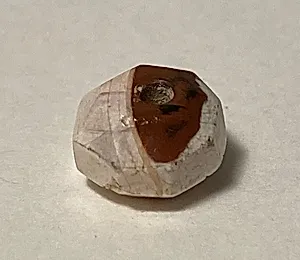
Medium
Stone
Dimensions
Diam. 1/4 in. (0.7 cm) D. 3/16 in. (0.5 cm)
Classification
Stone
Department
Islamic Art
Museum
Metropolitan Museum of Art, New York, NY
Credit
Rogers Fund, 1948
Accession Number
48.101.83
Rights
Public Domain
Art Historical Context
This unassuming stone bead, dating from the 8th to 13th century, offers a glimpse into the everyday artistry of the Islamic world. Crafted from durable stone and measuring just a quarter-inch in diameter and three-sixteenths of an inch deep, it exemplifies the precision of ancient lapidary techniques. Such beads were likely produced across regions from the Abbasid heartlands to the edges of the Islamic empire, where skilled artisans carved and drilled hard stones like carnelian, agate, or jasper—materials prized for their longevity and aesthetic appeal. In the context of Islamic art, beads held both practical and cultural significance. They adorned jewelry, amulets, and prayer strands (tasbih), serving as personal talismans or markers of devotion. Their small scale belies the technical mastery required: drilling a perfect central hole through solid stone demanded specialized tools and patience, reflecting a thriving trade network that exchanged these diminutive treasures along Silk Road routes. This example, acquired through the Rogers Fund in 1948, highlights how even humble objects preserve the ingenuity of medieval Islamic craftsmanship. Today, housed in the Metropolitan Museum of Art's Islamic Art department, the bead invites us to appreciate the artistry in the miniature—reminding visitors that beauty and history often hide in the smallest details.