
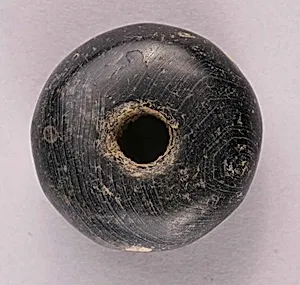
Beads
Unknown Artist
8th–13th century
Medium
Stone, probably jet; drilled
Dimensions
W. 13/16 in. (2.1 cm) Diam. 11/16 in. (1.7 cm)
Classification
Stone
Department
Islamic Art
Museum
Metropolitan Museum of Art, New York, NY
Credit
Rogers Fund, 1948
Accession Number
48.101.193c
Rights
Public Domain
Art Historical Context
These delicate stone beads, crafted by an unknown artist between the 8th and 13th centuries, exemplify the everyday artistry of the Islamic world. Made from jet—a glossy, lightweight black lignite prized for its deep luster and workability—they measure just 13/16 inch wide and 11/16 inch in diameter. Skillfully drilled for stringing, they were likely part of necklaces, bracelets, or prayer beads, blending functionality with subtle elegance. In the medieval Islamic period, spanning the Abbasid Caliphate and beyond, such beads held both practical and cultural significance. Jet, sourced from regions like Anatolia or the Caspian Sea, was a popular material for personal adornment across the vast Islamic trade networks, from Spain to Central Asia. These small objects reflect the era's mastery of lapidary techniques, where artisans hand-drilled precise holes using bow drills or abrasives, showcasing precision in an age before modern tools. Today, housed in the Metropolitan Museum of Art's Islamic Art department (acquired via the Rogers Fund in 1948), these beads offer a window into intimate aspects of daily life—fashion, devotion, or even talismanic protection. Their unassuming beauty reminds us how ordinary items carried profound cultural weight in a golden age of craftsmanship.