
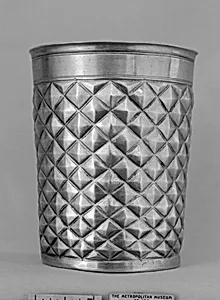
Beaker
ca. 1670–71
Medium
Silver gilt
Dimensions
Overall: 3 7/8 × 3 1/8 in. (9.8 × 7.9 cm)
Classification
Metalwork-Silver
Culture
German, Augsburg
Department
European Sculpture and Decorative Arts
Museum
Metropolitan Museum of Art, New York, NY
Credit
Rogers Fund, 1912
Accession Number
12.228.8
Rights
Public Domain
Art Historical Context
This delicate silver gilt beaker, crafted the Augsburg goldsmith Georg Rel around 1670–71, captures the opulence of late 17th-century German metalwork. Standing just under 4 inches tall, it served as a luxurious drinking vessel, its gilded surface gleaming with a warm golden sheen achieved through fire gilding—a technique where a mercury-gold amalgam was applied to silver and heated, creating a radiant, durable finish prized by the elite. Augsburg, in southern Germany, was Europe's premier center for silver production during this period, renowned for its skilled guilds and innovative designs influenced by Baroque extravagance. Reischl's work reflects this tradition, blending functionality with ornamental refinement typical of the city's output for courts and wealthy patrons. Such beakers were status symbols, often used in ceremonial settings. Today, this piece graces the Metropolitan Museum of Art's European Sculpture and Decorative Arts collection, acquired through the Rogers Fund in 1912. It offers a tangible glimpse into the craftsmanship that defined Augsburg's golden age of silversmithing.