
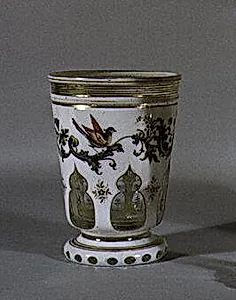
Beaker
Medium
White overlay glass, cut, polished, enameled, and gilt
Dimensions
Overall: 4 5/8 × 3 1/4 in. (11.7 × 8.3 cm)
Classification
Glass
Culture
Bohemian, Neuwelt (Nový Svet) with Prague decoration
Department
European Sculpture and Decorative Arts
Museum
Metropolitan Museum of Art, New York, NY
Credit
Munsey Fund, 1927
Accession Number
27.185.284
Rights
Public Domain
Tags
Art Historical Context
Step into the elegant world of 19th-century Bohemian glass with this exquisite *Beaker* from the Harrachsche Hütte in Neuwelt (Nový Svet), crafted around 1840 by Wilhelm Hoffman. Produced at one of Bohemia's premier glassworks, it exemplifies the region's mastery of luxury decorative arts during the Biedermeier, a time when intricate glassware symbolized refined taste and technical innovation. Adorned with motifs of birds—likely enameled and gilded for vivid detail—this piece was finished with sophisticated Prague decoration, blending rural glassblowing expertise with urban artistry. The beaker's medium, white overlay glass, is a highlight of Bohemian ingenuity: a thin white layer fused over a colored base, then meticulously cut and polished to reveal contrasting patterns beneath. Additional enameling and gilding add luminous color and gold accents, creating a jewel-like sparkle. Measuring just 4 5/8 × 3 1/4 inches, its compact form was ideal for intimate table settings or collections, showcasing the era's blend of functionality and opulence. Housed in The Metropolitan Museum of Art's European Sculpture and Decorative Arts department (acquired via the Munsey Fund in 1927), this beaker reflects Bohemia's global influence in glassmaking, rivaling porcelain in prestige. Visitors will appreciate how such objects transported owners to a world of natural beauty and craftsmanship.
About the Artist
Wilhelm Hoffman|Harrachsche Hütte ( | ) · 1808 | –1908 |
born 1808|