
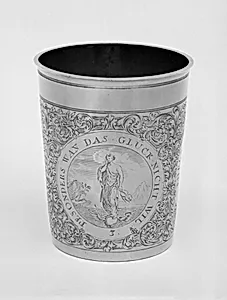
Beaker
1690–1700
Medium
Silver gilt
Dimensions
Overall: 4 × 3 1/4 in. (10.2 × 8.3 cm)
Classification
Metalwork-Silver
Culture
German, Augsburg
Department
European Sculpture and Decorative Arts
Museum
Metropolitan Museum of Art, New York, NY
Credit
Bequest of Alphonso T. Clearwater, 1933
Accession Number
33.120.74
Rights
Public Domain
Tags
Art Historical Context
Crafted by the skilled Augsburg silversmith Paulanier around 1690–1700, this exquisite silver gilt beaker exemplifies the pinnacle of late Baroque metalwork from southern Germany. Standing just 4 inches tall, its petite scale belies the opulence of silver coated in a thin layer of gold, a technique that lent a radiant, jewel-like sheen to elite tableware. Augsburg was Europe's premier hub for silver production during this era, renowned for its master craftsmen who combined technical virtuosity with lavish decoration to serve the nobility and burgeoning merchant class. The beaker's surface likely features finely chased or engraved scenes of men with violins, capturing the era's fascination with music as a symbol of refinement and leisure. These motifs reflect Baroque ideals of harmony, movement, and sensory delight, transforming a functional drinking vessel into a miniature stage for cultural performance. Such pieces were prized at lavish banquets, blending utility with artistry. Today, this treasure resides in The Metropolitan Museum of Art's European Sculpture and Decorative Arts collection, thanks to the 1933 bequest of Alphonso T. Clearwater. It offers a window into 17th-century German craftsmanship, where everyday objects became canvases for storytelling and splendor.