
Beaker
Unknown Artist
ca. 1676
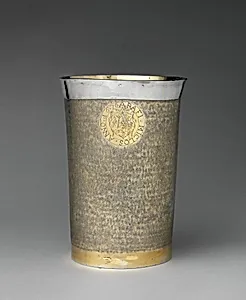
Medium
Silver, partly gilded
Dimensions
Overall: 9 7/16 x 6 7/8 in. (24 x 17.5 cm)
Classification
Metalwork-Silver
Culture
Hungarian, Brassó
Department
European Sculpture and Decorative Arts
Museum
Metropolitan Museum of Art, New York, NY
Credit
Gift of The Salgo Trust for Education, New York, in memory of Nicolas M. Salgo, 2010
Accession Number
2010.110.36
Rights
Public Domain
Art Historical Context
This elegant silver beaker, crafted around 1676 in Brassó (present-day Brașov,), exemplifies the refined metalworking traditions of 17th-century Transylvania Hungarian cultural influence. Standing at just over 9 inches tall, its partly gilded surface gleams with luxurious detail, where gold enhances the silver's luster to create a striking contrast. Such vessels were prized possessions, often used in ceremonial drinking rituals or as symbols of wealth and hospitality among the region's elite. The beaker's creation during this period reflects the Baroque era's emphasis on opulence and technical virtuosity in European decorative arts. Hungarian silversmiths in Brassó, a vibrant multicultural hub in the Kingdom of Hungary, drew on Central European techniques like chasing, embossing, and selective gilding to produce functional yet artistic objects. Mercury gilding, likely used here, involved applying a gold-mercury amalgam fired onto the silver, a skilled process that demanded precision to avoid toxicity. Today, this rare survivor of Hungarian silverwork graces the Metropolitan Museum of Art's European Sculpture and Decorative Arts collection, gifted by The Salgo Trust in 2010. It offers a tangible link to Transylvania's rich heritage, inviting visitors to appreciate the craftsmanship that bridged everyday life and aristocratic splendor.