
Beaker
500–1000 CE
Medium
Wood
Dimensions
H. 4 1/2 × W. 3 1/4 × D. 2 1/4 in. (11.4 × 8.3 × 5.7 cm)
Classification
Wood-Containers
Culture
Tiwanaku
Department
Arts of Africa, Oceania, and the Americas
Museum
Metropolitan Museum of Art, New York, NY
Credit
The Michael C. Rockefeller Memorial Collection, Purchase, Nelson A. Rockefeller Gift, 1968
Accession Number
1978.412.214
Rights
Public Domain
Tags
Art Historical Context
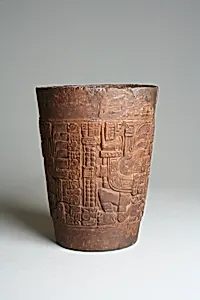
This elegant wooden beaker, crafted by Tiwanaku artists between 500 and 1000 CE, hails from the ancient Andean civilization centered near Lake Titicaca in-day Bolivia. Standing just 4½ inches tall, it exemplifies the Tiwanaku culture's mastery of portable art objects, used likely for rituals or elite feasting. Wood, though less common than ceramics or stone in surviving Tiwanaku artifacts, the society's skill in carving perishable materials, often sourced from high-altitude forests. The beaker's surface features animal motifs—a hallmark of Tiwanaku iconography—rendered in incised or low-relief designs that blend realism with stylized abstraction. These creatures, possibly felines, birds, or mythical hybrids, symbolized power, fertility, and cosmic forces in Tiwanaku cosmology, linking the earthly realm to the divine. Such vessels were integral to communal ceremonies, underscoring the culture's influence across the Andes before the rise of the Inca. Now part of The Metropolitan Museum of Art's Michael C. Rockefeller Memorial Collection, this beaker offers a window into Tiwanaku's sophisticated worldview, where everyday objects carried profound spiritual weight. Its compact form invites visitors to ponder the hands that shaped it over a millennium ago.