
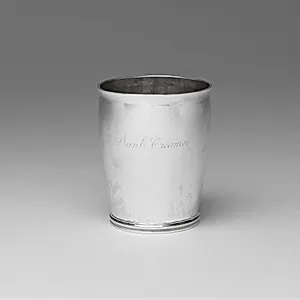
Beaker
1825–50
Medium
Silver
Dimensions
Overall: H. 3 7/16 in. (8.7 cm); 3 oz. 10 dwt. (108.4 g) Lip: Diam. 2 13/16 in. (7.1 cm) Base: Diam. 2 1/4 in. (5.7 cm)
Classification
Beaker
Culture
American
Department
The American Wing
Museum
Metropolitan Museum of Art, New York, NY
Credit
Bequest of Alphonso T. Clearwater, 1933
Accession Number
33.120.110
Rights
Public Domain
Art Historical Context
Nestled in The American Wing of the Metropolitan Museum of Art, this elegant silver beaker by John Goodhue exemplifies early 19th-century American. Crafted between 1825 and 1850, the piece measures a dainty 3 7/16 inches (8.7 cm) in height, with a lip diameter of 2 /16 inches (7.1 cm) and a base of 2 1/4 inches (5.7 cm), weighing in at 3 ounces 10 pennyweight (108.4 g). Its compact form suggests it was designed for personal use, likely as a drinking vessel for toddy, ale, or punch—common in American households of the era. Silver beakers like this one highlight the skill of regional silversmiths during a time when the United States was developing its own distinct artistic traditions, blending British influences with emerging American ingenuity. Goodhue, working in this post-Revolutionary period, produced functional yet refined objects that graced dining tables and taverns, symbolizing status and hospitality. The medium of silver, prized for its durability and luster, required masterful hammering, seaming, and polishing techniques, ensuring both beauty and utility. Bequeathed to the Met in 1933 by Alphonso T. Clearwater, this beaker offers a tangible link to everyday American life in the antebellum North. Visitors can appreciate how such modest treasures reflect the era's blend of practicality and quiet elegance, inviting us to toast to the silversmiths who shaped our material heritage.