
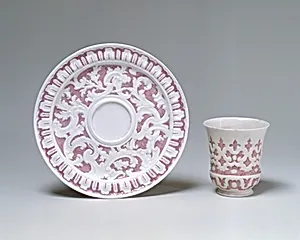
Beaker and saucer
Medium
Soft-paste porcelain
Dimensions
Beaker (.1): H. 2 3/4 in. (7.0 cm.); Saucer (.2): Diam. 6 1/6 in. (15.7 cm.)
Classification
Ceramics-Porcelain
Culture
Italian, Naples
Department
European Sculpture and Decorative Arts
Museum
Metropolitan Museum of Art, New York, NY
Credit
The Charles E. Sampson Memorial Fund, 1983
Accession Number
1983.95.1, .2
Rights
Public Domain
Art Historical Context
Nestled in the European Sculpture and Decorative Arts at the Metropolitan Museum of, this delicate *Beaker and Saucer* the Capodimontecelain Manufactory (. 1743) early Italian porcelain artistry. Produced in Naples under the patronage of King Charles III of, the manufactory was founded that very year in the royal palace of Capodimonte, Italy's ambitious entry into the competitive world of European porcelain production. The petite beaker, standing just 2¾ inches tall, pairs gracefully with its 6⅙-inch saucer, inviting admiration for their refined proportions and everyday elegance. Crafted from soft-paste porcelain—a friable yet luminous material blending clay, glass frit, and other ingredients—this set highlights a key 18th-century innovation. Unlike true hard-paste porcelain from China or Meissen, soft-paste offered artists greater malleability for intricate modeling and vibrant glazing, though it required careful firing to achieve its signature translucency. Capodimonte wares, often adorned with mythological scenes or floral motifs (though specifics here are understated), bridged utility and luxury, serving both royal tables and collectors. Acquired through The Charles E. Sampson Memorial Fund in 1983, this piece whispers of Naples' cultural renaissance, where Bourbon ambitions fueled artistic excellence. For visitors, it’s a tangible link to an era when porcelain rivaled gold in prestige, blending Neapolitan flair with international sophistication.