
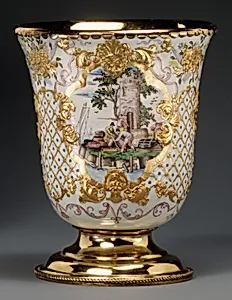
Beaker (one of a pair)
Medium
Painted enamel on copper, partly gilt; silver gilt
Dimensions
Height: 3 5/8 in. (9.2 cm); Diameter: 2 7/8 in. (7.3 cm)
Classification
Enamels-Painted
Culture
German, probably Berlin
Department
European Sculpture and Decorative Arts
Museum
Metropolitan Museum of Art, New York, NY
Credit
Gift of Irwin Untermyer, 1964
Accession Number
64.101.395
Rights
Public Domain
Tags
Art Historical Context
This exquisite beaker, one of a matching pair crafted around 1730–40 in a workshop linked to Charles Fromery, Friedrich Herold, and. G. V., hails from Germany—likely Berlin. During this era, Berlin emerged as a hub for fine decorative arts, where skilled artisans produced luxury objects for Europe's elite. Donated to the Metropolitan Museum of Art in 1964 by Irwin Untermyer, it the city's reputation for intricate enamel work, blending artistry with technical mastery. Fashioned from painted enamel on copper, with partial gilding and silver gilt accents, the beaker stands just 3⅝ inches tall and 2⅞ inches wide—perfect for intimate display or use at a grand table. Painted enamels, a demanding technique involving finely ground glass fused to metal at high temperatures, allowed for vibrant, jewel-like scenes that endured without fading. The motifs of towers and men evoke architectural grandeur and human figures, possibly alluding to civic pride or allegorical themes common in Rococo-era decorative pieces. As a highlight of European enamels, this beaker showcases the collaborative genius of Berlin workshops, where goldsmiths and enamelers pushed the boundaries of miniature painting. Visitors will appreciate its shimmering surfaces, a testament to 18th-century innovation in everyday luxury.