
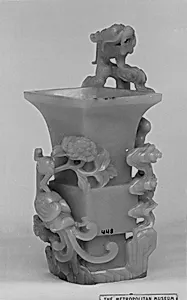
Beaker-Shaped Vase with Dragon and Phoenix (Hua Gu)
Unknown Artist
Medium
Nephrite, white with light greenish tint
Dimensions
H. 7 1/8 in. (18.1 cm); W. 3 3/8 in. (8.5 cm); L. 2 9/16 in. (6.5 cm)
Classification
Jade
Culture & Period
China · Qing dynasty (1644–1911), Kangxi period (1662–1722)
Department
Asian Art
Museum
Metropolitan Museum of Art, New York, NY
Credit
Gift of Heber R. Bishop, 1902
Accession Number
02.18.448
Rights
Public Domain
Tags
Art Historical Context
This exquisite beaker-shaped vase, carved from nephrite jade with a soft white hue and subtle greenish tint, exemplifies the masterful jade craftsmanship of China's Qing dynasty during the Kangxi period (2–1722). at 7 1/8 inches tall, its elegant form—narrow at the base and flaring outward like a flower—served both decorative and ritual purposes in elite households, evoking ancient bronze ritual vessels while showcasing imperial luxury. The vase's surface features dynamic dragons and phoenixes amid floral motifs, symbols of supreme power, harmony, and prosperity in Chinese culture. Dragons embodied the emperor's authority, while phoenixes represented the empress and feminine virtue; their intertwined forms suggest auspicious unions. Nephrite, revered for its toughness and translucency, was a material of profound cultural significance, linked to purity, immortality, and moral integrity since Neolithic times. Artisans in the Kangxi era revived jade carving techniques, polishing and incising intricate designs with precision to highlight the stone's natural veining. Gifted to the Metropolitan Museum of Art in 1902 by Heber R. Bishop, this anonymous masterpiece from the Asian Art collection invites visitors to appreciate the Qing court's artistic zenith, where jade transcended mere ornament to embody cosmic balance and eternal elegance.