
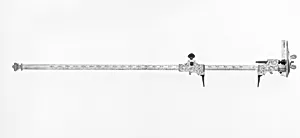
Beam compass
Medium
Brass gilt
Dimensions
Length: 11 1/4 in. (28.6 cm)
Classification
Metalwork-Brass
Culture
German, Dresden
Department
European Sculpture and Decorative Arts
Museum
Metropolitan Museum of Art, New York, NY
Credit
Bequest of W. Gedney Beatty, 1941
Accession Number
41.160.721
Rights
Public Domain
Art Historical Context
Crafted in 1619 by Christopher Trechsler, a metalworker from Dresden,, this elegant beam compass the exquisite metalwork of early 17-century Europe. Measuring 11¼ inches in length, the instrument is fashioned from brass, meticulously gilded to achieve a luxurious golden sheen that highlights its intricate engravings and balanced proportions. As a tool for draftsmen, architects, and navigators, the beam compass allowed for drawing precise large circles by adjusting sliding points along a straight beam—a practical innovation in an era of expanding scientific inquiry and artistic ambition. Trechsler's work reflects Dresden's prominence as a hub for fine craftsmanship during the late Renaissance and early Baroque periods, where functional objects like mathematical instruments were elevated to decorative arts through superior metallurgy and gilding techniques. The gilt brass not only protected the metal from corrosion but also symbolized status, blending utility with opulence for elite patrons. Housed in the Metropolitan Museum of Art's Department of European Sculpture and Decorative Arts, this piece—bequeathed by W. Gedney Beatty in 1941—offers a window into the interplay of art, science, and technology in Renaissance Germany. Today, it reminds us how everyday tools became treasures, showcasing the artisan's mastery in turning brass into gleaming precision.