
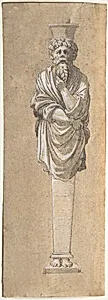
Bearded Male Term Covered in a Cloak
ca. 1545–65
Medium
Pen and black ink with gray wash, heightened with white
Dimensions
each: 11 7/16 x 3 15/16 in. (29 x 10 cm)
Classification
Drawings|Ornament & Architecture
Department
Drawings and Prints
Museum
Metropolitan Museum of Art, New York, NY
Credit
Harry G. Sperling Fund, 2009
Accession Number
2009.338b
Rights
Public Domain
Tags
Art Historical Context
This exquisite drawing, titled *Bearded Male Term Covered a Cloak*, hails from mid-16th-century Franceca. 1545–65) and captures the Renaissance fascination with classical antiquity. Created anonymously by a skilled French artist, it depicts a muscular, bearded male figure rendered as a "term"— hybrid sculptural form blending human bust and pillar, often used as architectural supports or ornamental motifs in grand palaces and gardens. Such designs echoed ancient Roman herms, revived during the French Renaissance to adorn châteaus like those at Fontainebleau, symbolizing strength and guardianship. The artwork's classification under Drawings|Ornament & Architecture highlights its practical role as a preparatory study, likely for stucco, stone carving, or fresco decoration. At 11 7/16 x 3 15/16 inches, its intimate scale belies its monumental intent, showcasing how draftsmen bridged imagination and execution in an era of opulent royal patronage under kings like Henry II. Crafted in pen and black ink with gray wash, heightened with white on prepared paper, the technique masterfully conveys volume and texture—the cloak's heavy folds contrast the figure's rugged form, with white gouache adding luminous highlights for three-dimensionality. Acquired through the Harry G. Sperling Fund in 2009 at The Metropolitan Museum of Art, this rare survivor offers a window into the inventive world of Renaissance ornamental design.