
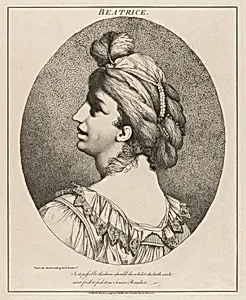
Beatrice
Medium
etching on wove paper
Dimensions
plate: 40.5 × 33 cm (15 15/16 × 13 in.) sheet: 54 × 38.5 cm (21 1/4 × 15 3/16 in.)
Classification
Department
CG-E
Museum
National Gallery of Art, Washington, D.C.
Credit
Gift of Thomas Vogler in memory of his brother Donald J. Vogler
Accession Number
2017.53.62
Rights
Public Domain
Art Historical Context
John Hamilton Mortimer's *Beatrice* (1776) is a striking etching on wove paper a relatively new and smooth substrate at the time that allowed for finer detail and tonal subtlety in printmaking. Measuring 40.5 × 33 cm on the plate, this work exemplifies Mortimer's mastery of the etching technique, where acid bites into a metal plate to create intricate lines and textures. Produced during the late Enlightenment era in Britain, it reflects the period's fascination with dramatic narratives and expressive figures. Mortimer (1740–1779), a pivotal British artist bridging Rococo elegance and emerging Romanticism, was renowned for his bold, theatrical compositions inspired by history, literature, and Salvator Rosa's rugged bandit scenes. Often working in prints to reach wider audiences, he infused his etchings with gothic intensity and emotional depth, prefiguring the Romantic movement. *Beatrice*—likely evoking literary heroines from Dante or Shakespeare—captures this flair through its dynamic form and shadowy contrasts. Housed in the National Gallery of Art's Prints department (CG-E), this piece was generously gifted by Thomas Vogler in memory of his brother Donald J. Vogler. For visitors, it offers a window into 18th-century print culture, where affordable etchings democratized art, blending technical innovation with Mortimer's vivid imagination.
About the Artist
John Hamilton Mortimer · 1740–1779
Comment on works: History; Portraits; Genre