
Beatus
Ernst Oppler, 1920
About this artwork
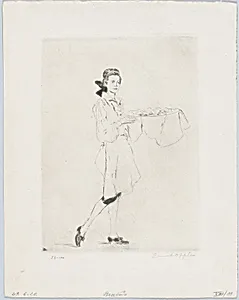
**Beatus** (1920) is a refined etching by German artist Ernstpler, showcasing his mastery of printmaking during the early interwar years. Measuring 7 7/8 x 5 7/8 inches (20 x 14.9 cm) on the plate and housed in the Metropolitan Museum of Art's and Prints department, this work entered the collection as a gift M.P. Epstein in1967. The intimate scale invites close viewing, revealing the precision of Oppler's etched lines. Titled *Beatus*—Latin for "blessed"—the print evokes spiritual themes through its subjects: women and monks. These figures likely suggest a contemplative religious scene, blending human intimacy with monastic devotion, common in early 20th-century European art exploring faith amid modern upheaval. Oppler's etching technique, an intaglio process where acid bites into a metal plate, allowed for subtle textures and expressive depth, making it ideal for nuanced portraits and symbolic narratives. As a classified print, *Beatus* highlights etching's role in democratizing art—affordable yet sophisticated multiples that brought personal visions to wider audiences. A gem for visitors pondering the intersections of spirituality and daily life, it captures a moment of quiet reverence in turbulent times.