
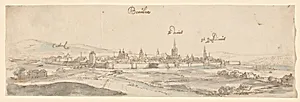
Beaulne (Beaune)
c. 1650
Medium
pen and brown ink with brown and blue wash over graphite on laid paper
Dimensions
sheet: 9.5 × 30.2 cm (3 3/4 × 11 7/8 in.)
Classification
Drawing
Department
CG-E
Museum
National Gallery of Art, Washington, D.C.
Credit
Purchased as the Gift of Diane A. Nixon
Accession Number
2014.106.1
Rights
Public Domain
Art Historical Context
Jan Peeters I, a Flemish artist of the 17th century created *Beaulne (Beaune)* around 1650, capturing the charming town of Beaune in Burgundy, France. Active in Antwerp during the Baroque era, Peeters belonged to a family of marine and landscape painters, contributing to the vibrant tradition of detailed topographical views that bridged Northern European art's focus on nature and architecture. This delicate drawing exemplifies his skill in rendering panoramic landscapes, as a study for larger paintings, reflecting the era's fascination with travel sketches and precise observation. Executed in pen and brown ink with brown and blue washes over graphite on laid paper—a favored 17th-century support for preparatory works—the piece measures a slender 9.5 × 30.2 cm, ideal for portable fieldwork. The layered technique builds depth: graphite underdrawing for faint outlines, ink for crisp lines, and subtle washes for atmospheric tone, evoking the misty horizons typical of Flemish landscapes. Such methods highlight the technical virtuosity of Baroque draughtsmen, who prized spontaneity alongside meticulous detail. Housed in the National Gallery of Art's Prints and Drawings department (CG-E), this work was generously purchased as the gift of Diane A. Nixon. It offers visitors a window into Peeters' process, underscoring the cultural role of drawings as both standalone gems and foundational art forms in the Dutch and Flemish Golden Age.