
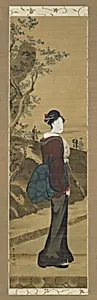
Beauty at the Mimeguri Shrine
Edo period, Bunka era c. 1804/18
Medium
Hanging scroll; ink, colors and gold pigment on silk
Dimensions
70.5 × 26.5 cm (27 3/4 × 10 7/16 in.); Mounting: 158.1 × 37.2 cm (62 1/4 × 14 5/8 in.); Width including lower roller: W.: 42.6 cm (16 3/4 in.)
Classification
hanging scroll
Department
Arts of Asia
Museum
Art Institute of Chicago
Accession Number
32132
Rights
Public Domain
About this artwork
This fashionable woman is enjoying a cool evening by the Mimeguri Shrine, located on an embankment of the Sumida River, which flows through central Tokyo. Her clothing advertises her sophistication: a chic lightweight black kimono that reveals the colors of her robes underneath, with a complementary obi (sash). Toyohiro was a second-generation artist of the Utagawa School, the most prominent painters of ukiyo-e, or “floating world” pictures. The phrase “floating world” describes a way of life in...
Art Historical Context
Step into the vibrant world of Edo-period Japan with *Beauty at the Mimeguri*, a delicate hanging scroll by Utag Toyohiro (1773–1825), during the Bunka era around 1804–1818. Toyohiro, a master the Utagawa school and mentor to Hiroshige, the elegance of a bijin—a celebrated beauty—poised at the historic Mimeuri Shrine in Edo (modern Tokyo). This artwork reflects the ukiyo-e tradition of "pictures of the floating world," blending urban sophistication with serene natural settings amid the prosperity of Japan's Tokugawa shogunate. Crafted on silk with ink, vibrant colors, and lavish gold pigment, the scroll measures 70.5 × 26.5 cm, designed for ceremonial display when unrolled. Hanging scrolls like this were prized possessions in elite homes, symbolizing refined taste and seasonal appreciation. Toyohiro's precise lines and subtle shading evoke the grace of the geisha class, while gold flecks likely mimic shimmering sunlight or shrine lanterns, heightening the scene's ethereal allure. Housed in the Art Institute of Chicago's Arts of Asia collection, this piece offers a window into 19th-century Japanese culture, where beauty intertwined with spirituality and fleeting pleasures. A testament to Toyohiro's influence on later ukiyo-e giants, it invites visitors to savor the artistry of everyday transcendence.
About the Artist
Utagawa Toyohiro · 1763–1828
Utagawa Toyohiro (1763–1828) was a Japanese ukiyo-e artist and painter who founded a major branch of the Utagawa school and is best remembered as the teacher of Utagawa Hiroshige, one of the greatest landscape print designers in Japanese art history. Born in Edo (present-day Tokyo), he studied under Utagawa Toyoharu, the founder of the Utagawa school, who was noted for introducing Western perspect...