
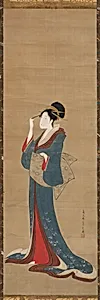
Beauty Replacing Her Hairpin
Edo period, 1798
Medium
Hanging scroll; ink and color on silk
Dimensions
93.2 × 30.6 cm (36 3/4 × 12 1/16 in.)
Classification
hanging scroll
Department
Arts of Asia
Museum
Art Institute of Chicago
Accession Number
24445
Rights
Public Domain
Art Historical Context
Chôbunsai Eishi's *Beauty Replacing Her Hairpin (1798) captures the refined elegance of Edo-period Japan, a time when ukiyo-e artists celebrated the "floating world" of urban pleasures. Eishi, a master bijin-ga (images of women), specialized in portraying courtesans and ladies with graceful poise and subtle emotion. This hanging scroll depicts a solitary beauty in an intimate moment, adjusting her hairpin—a gesture symbolizing femininity and daily ritual amid the opulent Yoshiwara pleasure district culture. Rendered in ink and color on silk, the work exemplifies traditional Japanese techniques: delicate mineral pigments and gold flecks create luminous skin tones and flowing kimono patterns, while precise ink lines define contours with fluid elegance. At 93.2 × 30.6 cm, its narrow format suits vertical display in a tokonoma alcove, inviting contemplation during tea ceremonies or seasonal gatherings. Housed in the Art Institute of Chicago's Arts of Asia collection, this scroll highlights Eishi's shift from woodblock prints to painting, blending realism with idealized beauty. It offers a window into 18th-century Japanese aesthetics, where such artworks adorned private spaces, evoking tranquility and sensuality for discerning collectors.
About the Artist
Chôbunsai Eishi · 1756–1829
Chôbunsai Eishi, born Hosoda Tokitomi in 1756 to a prosperous samurai family of the Fujiwara clan in Edo, inherited a substantial stipend of 500 koku of rice annually. His grandfather had served as the shogunate's Treasury Minister, and upon his father Hosoda Tokiyuki's death in 1772, Eishi became family head while holding a position in Shogun Tokugawa Ieharu's palace from 1781. Unusually for a uk...