
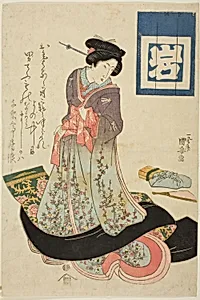
Beauty representing spring, from an untitled series of beauties representing the four seasons
c. 1818/30
Medium
Color woodblock print; oban
Dimensions
37.5 × 25.1 cm (14 3/4 × 9 7/8 in.)
Classification
Department
Arts of Asia
Museum
Art Institute of Chicago
Accession Number
32977
Rights
Public Domain
Art Historical Context
In the vibrant world of Edo-period Japan (1603–1868), Utagawa Kuniyasu, a talented pupil of the Utagawa Toyokuni I, crafted this enchanting *Beauty representing spring* around 1818–1830. Part of an untitled series depicting beauties embodying the four seasons, color woodblock print exemplifies *bijin-ga*—images of elegant women that captured the fleeting pleasures of the "floating world" (*ukiyo-e*). The oban format (37.5 × 25.1 cm), a popular large size for such prints, allowed for intricate details visible from afar, making it ideal for urban audiences in theaters or teahouses. Kuniyasu's mastery shines in the woodblock technique, where multiple carved blocks were inked in vibrant hues and precisely overlaid to create lifelike textures—from the soft folds of the woman's kimono adorned with spring cherry blossoms to her graceful pose evoking renewal and youth. This medium democratized art, as affordable prints proliferated during Japan's peaceful Tokugawa era, reflecting societal fascination with beauty, nature, and seasonal cycles central to Japanese aesthetics. Held in the Art Institute of Chicago's Arts of Asia collection, this print offers a window into 19th-century Japanese culture, where women symbolized harmony with nature. Imagine a geisha or courtesan poised amid blooming flowers, inviting viewers to savor spring's ephemeral charm.