
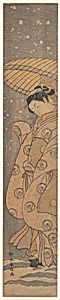
Beauty under an Umbrella in the Snow
ca. 1770
Medium
Woodblock print (pillar print); ink and color on paper
Dimensions
H. 26 3/4 in. (67.9 cm); W. 5 in. (12.7 cm)
Classification
Prints
Culture & Period
Japan · Edo period (1615–1868)
Department
Asian Art
Museum
Metropolitan Museum of Art, New York, NY
Credit
Rogers Fund, 1922
Accession Number
JP1376
Rights
Public Domain
Tags
Art Historical Context
Suzuki Harunobu's *Beauty under an Umbrella the Snow* (ca. 1770) is a delicate woodblock print from Japan's Edo period (16151868), capturing the fleeting elegance of everyday life in the "floating world" of ukiyo-e art. This narrow pillar print—measuring just 5 inches wide by over 26 inches tall—was designed for posting on architectural pillars, a popular format that allowed intricate vertical compositions to grace urban spaces like teahouses and theaters. Harunobu, a master innovator, pioneered full-color nishiki-e (brocade prints) around 1765, layering ink and pigments with exquisite precision to achieve vibrant hues and subtle gradients. Here, the solitary woman shielding herself with an umbrella amid falling snow evokes quiet introspection and seasonal beauty, a hallmark of bijin-ga (pictures of beautiful women). The cool palette of whites, blues, and soft pinks highlights her graceful poise, blending realism with poetic lyricism. As one of Harunobu's later works, this print reflects the height of ukiyo-e's golden age, celebrating feminine allure against nature's stark canvas. Acquired through the Rogers Fund in 1922, it's a gem in the Metropolitan Museum of Art's Asian Art collection, inviting visitors to ponder the artistry of impermanence in 18th-century Japan.
About the Artist
Suzuki Harunobu · 1725–1770
Suzuki Harunobu (c. 1725-1770) was a Japanese ukiyo-e artist who revolutionized woodblock printing by developing nishiki-e—full-color prints using multiple woodblocks—in 1765. Before Harunobu, Japanese prints were limited to two or three colors; his innovation unleashed the entire artist's palette, transforming ukiyo-e into the vibrant art form that would later captivate Western artists from Manet...