
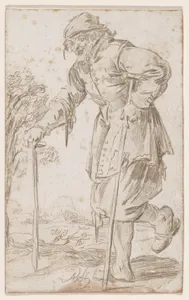
Beggar Walking on a Crutch
ca. 1632
Medium
Metalpoint on prepared paper
Dimensions
Sheet: 4 3/4 × 6 7/8 in. (12 × 17.5 cm)
Classification
Drawings
Department
Drawings and Prints
Museum
Metropolitan Museum of Art, New York, NY
Credit
Frits and Rita Markus Fund, 2018
Accession Number
2018.674
Rights
Public Domain
Tags
Art Historical Context
In the intimate drawing *Beggar Walking on autch*, Andries Both captures a poignant moment of human struggle from the Dutch Golden Age. Created around 1632, this small-scale work (4 3/4 × 6 7/8 in.) depicts a figure hobbling on a crutch, embodying Both's fascination with everyday life among the lower classes. As a member of the Utrechtaggisti, Both drew inspiration from Caravaggio's dramatic realism, infusing his genre scenes—often called *bambocciate*—with authenticity and empathy for the marginalized. The medium, metalpoint on prepared paper, is a masterful choice that highlights Both's technical prowess. This Renaissance technique uses a metal stylus (likely silver) to deposit fine particles on a specially coated surface, yielding precise, luminous lines that excel at rendering textures like worn fabric and rough wood. Such drawings were prized as independent studies or preparatory sketches, showcasing an artist's dexterity in an era when paper was costly. Acquired through the Frits and Rita Markus Fund and now in the Metropolitan Museum of Art's Drawings and Prints department, this piece reflects 17th-century Europe's growing interest in humanism and social observation. It invites us to pause and appreciate the dignity in hardship, a timeless reminder of art's power to humanize the overlooked.
About the Artist
Andries Both · 1612–1641
**Andries Both** (c. 1612/1613–1642) was a Dutch genre painter best known for his lively depictions of everyday life among the lower classes in Rome and its countryside. Born in Utrecht as the son of glass painter Dirck Both, he trained alongside his brother Jan under the prominent Utrecht master Abraham Bloemaert, with records confirming his apprenticeship in 1624–1625. Both and his brother trav...